Overview
Inquiry is a form of respect
Eunomology™ is a field of inquiry that asks how coherent systems emerge and whether the same organising principles can be recognised across nature, human systems, and culture.Derived from the Greek eu (good, harmonious, true) and nomos (law, principle, ordering), the term may be understood as the study of good order, or more broadly, the study of harmonious ordering principles.Developed by Lalita Green, Eunomology is a metatheoretical framework for investigating these underlying principles. While closely related to disciplines such as biomimetics, cybernetics, and complexity science, it operates at a higher level of abstraction, providing a common lens for exploring how these principles are expressed across disciplines that are often studied in isolation.
Architecture
of Eunomology
EUNOMOLOGY
The Field of Inquiry
│
▼
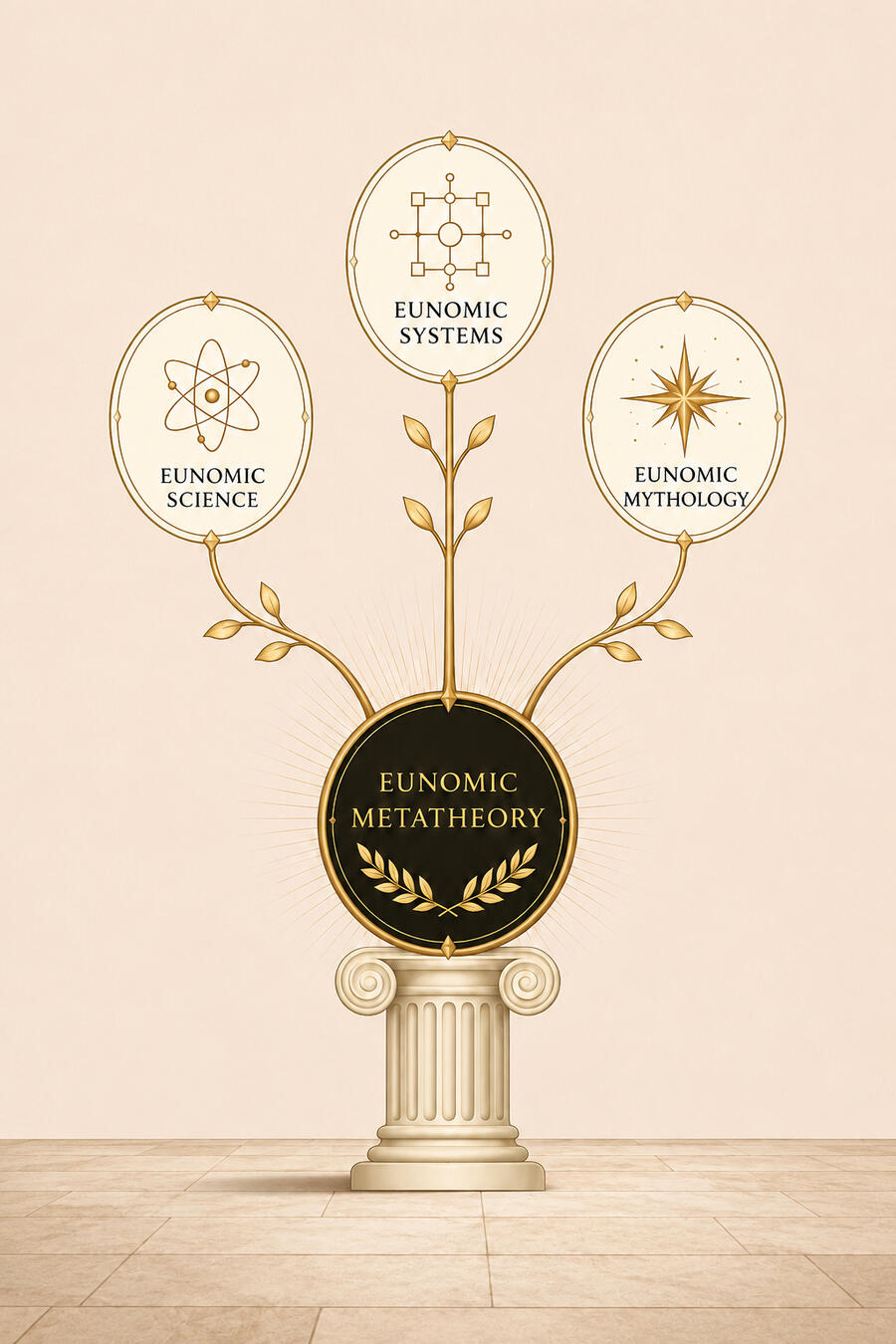
EUNOMIC METATHEORY
First Principles of Order
│
▼ ▼ ▼
THE TRIADIC EXPRESSION
[Science] [Systems] [Mythology]
Eunomic Metatheory
The Eunomic Metatheory is the core logic and first principles from which Eunomology proceeds. It acts as a meta-framework that organises and relates other frameworks by defining the principles and patterns through which order, relation, and emergence can be understood across scales.The term metatheory is used here in its original sense, derived from the Greek meta ("beyond" or "higher") and theōria ("contemplation" or "seeing").Beneath the Metatheory, Eunomology branches into three distinct, co-equal modes of inquiry. Together, these domains translate its underlying principles into different forms of human understanding, grounded in observation and expressed through culture.Note: Throughout Eunomology, foundational terms are understood according to their original definitions. Rather than assigning new meanings to familiar concepts, the framework seeks to recover their original function before extending them into a broader theoretical context.
Eunomic Science
Domain: Observable Reality
Mode: Empirical Investigation
Output: DataEunomic Science seeks to discover how ordering principles manifest within physical, biological, ecological, and cognitive systems through observation, measurement, and experimentation.The term science is used here in its original sense, derived from the Latin scientia ("knowledge"), referring to the disciplined pursuit of knowledge rather than the modern scientific establishment or any particular institution.Eunomic Science studies what nature does.
Eunomic Systems
Domain: Society & Technology
Mode: Engineering & Stewardship
Output: DesignEunomic Systems applies the ordering principles identified through Eunomic Science to the intentional design and stewardship of human systems, including organisations, technologies, infrastructure, economies, and governance. Its aim is to prioritise resilience and internal coherence over short-term optimisation.The term systems is used here in its original sense, derived from the Greek systēma ("that which is brought together"), referring to organised wholes and coordinated relationships rather than particular institutions or bureaucratic structures.Eunomic Systems studies what humans build.
Eunomic Mythology
Domain: Psyche & Culture
Mode: Symbolic Interpretation
Output: MeaningEunomic Mythology explores how underlying order is expressed through archetypes, symbols, stories, and cultural narratives. It examines how symbolic narratives help people make sense of the world and themselves, translating abstract principles into forms that can be understood, remembered, and lived.The term mythology is used here in its original sense, derived from the Greek mythos ("story" or "narrative"), referring to symbolic narratives rather than the modern colloquial sense of something false. Myths are understood as symbolic narratives that encode and transmit meaning across individuals, cultures, and generations.Eunomic Mythology studies why truth matters.
The Triadic Expression
Civilisations remain coherent through the interaction of these three complementary functions. Science maintains correspondence with reality. Systems organise collective action. Mythology generates shared meaning. While Science continually calibrates civilisation against reality, Systems and Mythology interact to co-create culture. The culture they create, in turn, shapes the questions that guide future scientific inquiry.These are not three independent domains, but three complementary expressions of the same underlying order: Science discovers it, Systems embody it, and Mythology makes it meaningful. Together, they form a continuous cycle in which reality is understood, embodied, interpreted, and explored anew.
Why Eunomology?
Modern science has produced extraordinary insight into the workings of the natural world. Alongside it, fields such as systems thinking, cybernetics, biomimetics, complexity science, ecology, network science, and systems engineering have developed powerful ways of understanding relationships, adaptation, regulation, and emergence.Eunomology does not seek to replace these disciplines, nor to subsume them. Each has its own methods, questions, and domains of expertise.Instead, Eunomology asks a different question.Rather than asking how a particular system works, it asks whether there are higher-order organising principles that recur across many different kinds of systems—biological, physical, social, technological, and cultural.In this sense, Eunomology operates as a metatheoretical framework, providing a common language for recognising the organising principles that underlie coherent systems wherever they arise.Where systems thinking maps relationships, Eunomology asks why certain relationships remain coherent.Where cybernetics studies regulation and feedback, Eunomology asks what principles make regulation possible.Where complexity science investigates emergence, Eunomology asks whether emergence itself reflects deeper organising principles.Where biomimetics learns from nature's designs, Eunomology asks why those designs exhibit coherence in the first place.Rather than replacing existing knowledge, Eunomology seeks to reveal coherent relationships between existing bodies of knowledge.Its aim is not to reduce diverse disciplines into a single theory, but to explore whether they are expressions of common ordering principles operating across different domains and scales.
If individual disciplines study particular expressions of order, Eunomology studies order itself.
Invention
The Eunomic Group
eunomic.group
Application
Planet Earth Co
planetearth.guide
Vision
The Eunomic Temple
eunomic-temple.org
EUNOMOLOGY
The Study Of Good Order
Contact:
Eunomology | © 2026